F O R G E + F R E S H E T
8.5.13
shakti and the midges
As I mentioned, I had the good fortune to be taken to a migratory bird refuge north of Salt Lake City- literally an 80,000 acre of asylum in the middle of the desert. The birds there make the air breathe and they are brave and ravenous. Every one of these birds comes to be nourished before they're gone; some stay on for a while, others just blow through, but no one stays permanently. So I thought it was a perfect setting to give up and be nourished. There happened to be a midge hatch- a lunacy of bugs so heavy it bent the grass. These bugs do not bite do not even have jaws. But they serve as a kind of living energetic scrub- you move through the clouds of them and emerge feeling more awake and aware (and a little put off.) I made myself stand near them. Uncomfortable at first (the way I feel with any act of receiving,) and then more at peace and finally completely stilled. It was rocky and disorienting at first. Like that idea of inhaling and exhaling equally: when I make my inhale equal to the exhale it has always been somewhat unpleasant. A strange thing to be so thrown off by one's own breath... But I'm sipping a little at a time, readying myself to let It in. Whatever It might be.


6.5.13
asylum
The big canyon empties into the valley, blushing green and delirious in blossoming trees. The valley's confetti of glass and steel gives way to the refineries: endless loops and arcs of enamel and steam. Then the parched and decimated towns that have sprung from the leachwater and finally the stillness of another valley; this one less peopled and wrangled.
Here the northeastern arm of the Great Salt Lake swings into the mouth of the Bear River and lays bare its throat of alkali fields, marshes, wetlands and grasses. There are 80,000 acres of carefully controlled wilderness here. Dikes and jetties corral the water up and down. In and out. It is marked asylum, safe haven, packaged respite.
In May, despite the broad heat, everything is still gold and dry from winter kill. Only the most slender green feet of the cattails have emerged, fresh and delicate and lost among the dead standing reeds from last summer.
Leaving the highway is like shedding a rigid husk. Nebulous and stunned we move out of the car. A split second of aching and slamming silence and stillness. And then. Sound. Whirring and palpable sound. First from one broad streak of river and then everywhere, behind our foreheads, in our clothes. Sounds like gravel being shaken in a brass bell, electric sounds split open with water, shorting and roaring. Sweet musical sounds snagged on the nodding grass, fringed sound and hoops of sound. Mostly it is from unseen life. To stand in one place and move only your eyes you'd think it was the marsh plants themselves singing. Faeries among discarded plastic cups, shotgun shells, plastic cutlery.
Birds abound- on purpose. With purpose. For this place lost among many thousand arid miles is an oasis for birds who live elsewhere. These birds stop through, eat, rest, surrender and move on. Sometimes they leave feathers and bones. Footprints. Mud cobbling. A few birds will stay on to breed and raise chicks, but eventually the magnet fibers thrill through their hollow bones and they move on with greater Purpose to wherever it is they Belong.
The names are beautiful, foreign. For desert dwellers all this water and taxonomy is otherwordly. Cinnamon teals. Yellow headed blackbirds. Cliff swallows. Great blue herons. White faced ibises. Canada geese. Plovers. Red necked stilts. American avocets.Great white pelicans. Even the more familiar birds seem exotic here: magpies, common finches, gulls. Terns and sea birds rent the air and, like falling spades, part the water and dredge up carp like bread loaves. Scales shock against the sun.
The air is alive with birds and midges. Squinting into the horizon flocks and swoops of birds will tip into view, throw wide beams of light off their blinding plumage, then tip back, dissolve. Disappear. We arrived in the midst of a midge hatch. Cyclones and lunatic masses of mosquito-like insects rising from the cupped faces of clover. These flies do not bite and tear. Not because they do not desire, but because they are made without jaws. The weight of them bends grass. Shivering and arcing columns of the bugs fringe the road like smoke signals. The noise, like warm hysteria, can be heard with the windows rolled up. Such a microcosm exploded.
Where the road spreads and stops a pavilion has been erected. Octagonal, fit with those plastic coated benches for addressing the marsh. But cliff swallows have taken over. Tiny birds, capable of lfying 46 miles per hour who spend eighty five percent of their furious lives in the air. The little mud gourds of nests have crept along the entire underside of the pavilion. Like soaring barnacles the swallows move in and out, calling and shifting, completely unafraid. The loudest sound we hard was the tap-tap of wings beating as we went to sit under the nests, not song, just air being shoved along. A moment of stillness, then the birds were back, bringing mouthfuls of mud and song to tack their nests together. The air was outrageous, disorienting, truly alive.
A sweep of dirt road clutches a central disc of wetlands in the center of the refuge. The rest cannot be entered by foot or on wheels. Twelve and a half miles is as much as you get to drive. It took us four and a half hours. We stopped every so often to let the midges alight on our elbows, to see pelicans knocks and bob against one another, to see herons spread wings wide as station wagons and heave themselves across still glass. The sun hit the water. Many little skies winked up from the ground. We rode a fine line of horizon, doubted how solid it was. Moved slowly so as not to slip out of time and place. We clutched each other every so often but didn't know why. We perched on the back of the car with a small sandwich in each hand and forgot to chew for long periods.
And then we re-entered the world. Returned to our clumsy bodies, moving hugely, anchored to the ground. We turned on the air conditioning, scanned the radio and then peered at each other with our brows drawn. Turned the radio off. Pointed our faces and our compass due north, tried to melt back into more familiar living world, the one bound to stillness, with decided gaping hole where bird song should be.
30.4.13
bread crumbs
It's important to be moved by the small miracles and the big ones. The small ones seem more profound- if only because they flash and blow for only a moment. And then, well, you're lucky you saw them at all.
This book has changed my life. Tosha Silver came to me unexpectedly, from a friend, with regards to facebook (which I don't DO.) And somehow, I found myself reading the exact words I needed for the exact moment in my life. I guess if you read Outrageous Openness it's not surprising that it manifested itself with such ease and profundity. Anyway, she's very sweet and silly and both of those things are what make 'aligning with the Divine,' as she says, completely palatable. Seriously.
There are small problems and snags here. Nothing like rips and holes, but decisions and snarls. Things that you wish someone had already done and could assure you with a pat on the cheek, "totally no big deal," in an offhanded way while tossing salad maybe. But alas. And so here are some words of Outrageous wisdom:
Additionally, today, I was given something rather important by someone at school. It was me, as a puppet. A good thing to have, perspective-wise.
And even though it's still bleak and barren out there (with some promises if you look closely enough,) it's enough to line the nest with feathers and feel safe looking out, until the Bread Crumbs materialize. I am so ready.
There are small problems and snags here. Nothing like rips and holes, but decisions and snarls. Things that you wish someone had already done and could assure you with a pat on the cheek, "totally no big deal," in an offhanded way while tossing salad maybe. But alas. And so here are some words of Outrageous wisdom:
"Hold the questions in your heart. Ask with complete focus and conviction for the Universe's guidance. Then let go and see what bread crumbs come for you to follow. If you don't get an answer, just keep asking for a while until you do."
Right?! Almost too easy. But truly, the question isn't "why would the Divine put in a hand and help me steer," it's more like "what else does the Divine have to do but offer me support and love?" And then, hand city. The deep slow water of peace and surrender. The steering isn't important, the vehicle doesn't need to be pushed at all.
So we'll see.
In the meantime, spring has at least graced others with flowers who can bestow them on me, in large commercial mustard tins, to prop and wedge into small vessels as I see fit. Which makes the house magnificent.
Additionally, today, I was given something rather important by someone at school. It was me, as a puppet. A good thing to have, perspective-wise.
And even though it's still bleak and barren out there (with some promises if you look closely enough,) it's enough to line the nest with feathers and feel safe looking out, until the Bread Crumbs materialize. I am so ready.
Labels:
deep thinking,
Outrageous Openness,
Tosha Silver
23.4.13
tuesday brioche (a la Bernard Clayton)
Cold today, cold yesterday, probably cold tomorrow. But not as cold as today. Which means? Obviously spending the day cold-proofing an egg-heavy butter-forward bowl of brioche dough. Clearly. It keeps a gal from feeling like she's going to keel over if she wakes up one more time this April, clutching both down comforters to her throat and dragging the dog up into the bed to warm her up before braving clothes. (Ugh..)
So!
This dough is lovely and it's a mess. Bernard Clayton , who seems to have this dream job of traveling the world, eating bread and making bread, warns us of this when we set out to get after something like brioche. Maybe because brioche (like croissant) strives to defy physics by maintaining integrity under stringent conditions and demands- mainly, more butter and eggs than you can imagine getting into three pounds of dough, and doing it all, like a champ, in the blustery cold of the fridge (or the frosty after-hour counter tops courtesy of a mountain spring.) He's very charming about it :
"...Continue slapping back the dough for about 18 -20 minutes. Don't despair. It is sticky. It is a mess. But it will slowly begin to stretch and pull away as you work it."
Which of course makes you feel like you should try to struggle through it, in the name of buttery pastry.
Brioche has a history, and fierce historian, and many people feel it should be done in one specific way, with no deviations whatsoever. And there are as many ways of making brioche as there are brioche historians, I imagine. For example, you could decide to do this over a period of four days (four?!), with a starter, without a starter. With a starter made from wild yeasts attracted to grape skins, or one made over the course of a month in a jar of a specific size. You could use cream cheese to enrich the dough, you could use anywhere form three to nine eggs. Truly. You have to have a decisive hand, and, most importantly, a clear idea of how much of your time you want to give to this dough. Because you could end up giving a lot.
Luckily for us, Bernard gives us a recipe for Brioche Without a Starter (pages 611 - 612.) Which can be done in one day if you start early, or over the course of two if you employ your refrigerator overnight.
This is what I did:
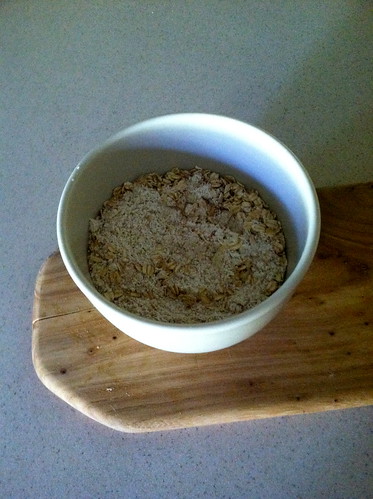
Into the bowl of a stand mixer I put:
2 cups of flour
3 teaspoons of yeast (I used extra because of my cold kitchen)
1/4 cup dried milk (I know right? but it's worth it, it adds silkiness)
1 tablespoon of sugar
1 cup of hot raw milk (or you could use water)

Then you fold it over itself, cover it in plastic and linen and leave it in the fridge for at least four hours, preferably overnight.
And, after folding it over on itself yet again to deflate it, you can divide it and shape it. This recipe makes three pounds of dough suitable for two loaves of bread. Knowing that I can easily sit down and eat almost an entire loaf of bread on my own, I made one loaf (the shape, made by laying balls of dough in a zig zag pattern along the bottom of the pan is called Brioche Nanterre,) and many small buns using a variety of little ceramic teacups I had greased and papered.
Shape the dough on a well floured work surface. Brioche is meant to be a stiff dough (like challah,) and this is due mainly to the abundance of butter that firms up as it chills. As with puff pastry or croissant dough, if you feel the dough softening under your hands as your work and becoming very elastic this is a sign that it has warmed up a bit too much and can cause the oven lift to be a bit weak and the shaping to lose its integrity. Despite pining to get this in the oven already, put it in the freezer for about ten minutes before going on. Why waste all your efforts now?


These need a while to warm to room temperature and to do their final rise. Give them between 90 minutes to two and a half hours. If baking in a loaf pan you want the dough to just meet the edges of the pan. With the teacups it's a softer time frame because they vary in size. Go for a rough doubling from them and hope for the best. Then in a 475 degree oven (dry heat for these,) put them in together and test after 25 minutes. As usual, the bottom of the loaf should ring hollow when wrapped with the knuckles.
So!
This dough is lovely and it's a mess. Bernard Clayton , who seems to have this dream job of traveling the world, eating bread and making bread, warns us of this when we set out to get after something like brioche. Maybe because brioche (like croissant) strives to defy physics by maintaining integrity under stringent conditions and demands- mainly, more butter and eggs than you can imagine getting into three pounds of dough, and doing it all, like a champ, in the blustery cold of the fridge (or the frosty after-hour counter tops courtesy of a mountain spring.) He's very charming about it :
"...Continue slapping back the dough for about 18 -20 minutes. Don't despair. It is sticky. It is a mess. But it will slowly begin to stretch and pull away as you work it."
Which of course makes you feel like you should try to struggle through it, in the name of buttery pastry.
Brioche has a history, and fierce historian, and many people feel it should be done in one specific way, with no deviations whatsoever. And there are as many ways of making brioche as there are brioche historians, I imagine. For example, you could decide to do this over a period of four days (four?!), with a starter, without a starter. With a starter made from wild yeasts attracted to grape skins, or one made over the course of a month in a jar of a specific size. You could use cream cheese to enrich the dough, you could use anywhere form three to nine eggs. Truly. You have to have a decisive hand, and, most importantly, a clear idea of how much of your time you want to give to this dough. Because you could end up giving a lot.
Luckily for us, Bernard gives us a recipe for Brioche Without a Starter (pages 611 - 612.) Which can be done in one day if you start early, or over the course of two if you employ your refrigerator overnight.
This is what I did:
Into the bowl of a stand mixer I put:
2 cups of flour
3 teaspoons of yeast (I used extra because of my cold kitchen)
1/4 cup dried milk (I know right? but it's worth it, it adds silkiness)
1 tablespoon of sugar
1 cup of hot raw milk (or you could use water)
When that was homogenized I added, a few tablespoons at a time
2 sticks of butter (soft)
and, one at a time
6 eggs (we have a glut of teenage eggs right now- the product of chickens new to laying who make many, luminous small and wompy eggs. Bernard requests only 5.)
And then, the balance of the flour (about 4 cups) a half a cup at a time until the dough comes together to form a heavy, sticky, mess of a dough.
This is the despair he warns about. Because it looks like pancake batter for a while. And then five minutes more. Then ten minutes more. In all it should stay in there for about twenty minutes. Switch to the bread hook when you can't imagine it needs more mixing. And then, in a flash (when you step away to warm more milk for your coffee,) it will become this beautiful, shiny, elastic dough that does actually clean the sides of the bowl. And you will be thrilled! And so glad you had a mixer instead of rock-hard french peasant woman arms that would be, otherwise, beat all to hell. Do no under any circumstances decide that your dough just won't come together and take it out from under the hook early. You will be so sad and so may eggs will have been wasted. Keep after it! And then get over it:
And then, the balance of the flour (about 4 cups) a half a cup at a time until the dough comes together to form a heavy, sticky, mess of a dough.
This is the despair he warns about. Because it looks like pancake batter for a while. And then five minutes more. Then ten minutes more. In all it should stay in there for about twenty minutes. Switch to the bread hook when you can't imagine it needs more mixing. And then, in a flash (when you step away to warm more milk for your coffee,) it will become this beautiful, shiny, elastic dough that does actually clean the sides of the bowl. And you will be thrilled! And so glad you had a mixer instead of rock-hard french peasant woman arms that would be, otherwise, beat all to hell. Do no under any circumstances decide that your dough just won't come together and take it out from under the hook early. You will be so sad and so may eggs will have been wasted. Keep after it! And then get over it:
Then you leave it to double (about 3 hours.)

Then you fold it over itself, cover it in plastic and linen and leave it in the fridge for at least four hours, preferably overnight.
And, after folding it over on itself yet again to deflate it, you can divide it and shape it. This recipe makes three pounds of dough suitable for two loaves of bread. Knowing that I can easily sit down and eat almost an entire loaf of bread on my own, I made one loaf (the shape, made by laying balls of dough in a zig zag pattern along the bottom of the pan is called Brioche Nanterre,) and many small buns using a variety of little ceramic teacups I had greased and papered.
Shape the dough on a well floured work surface. Brioche is meant to be a stiff dough (like challah,) and this is due mainly to the abundance of butter that firms up as it chills. As with puff pastry or croissant dough, if you feel the dough softening under your hands as your work and becoming very elastic this is a sign that it has warmed up a bit too much and can cause the oven lift to be a bit weak and the shaping to lose its integrity. Despite pining to get this in the oven already, put it in the freezer for about ten minutes before going on. Why waste all your efforts now?


These need a while to warm to room temperature and to do their final rise. Give them between 90 minutes to two and a half hours. If baking in a loaf pan you want the dough to just meet the edges of the pan. With the teacups it's a softer time frame because they vary in size. Go for a rough doubling from them and hope for the best. Then in a 475 degree oven (dry heat for these,) put them in together and test after 25 minutes. As usual, the bottom of the loaf should ring hollow when wrapped with the knuckles.
And that is what we call a productive Tuesday morning. Whew! If you're lucky you might have some sweet raw butter to eat with these. We're not that lucky. But we do have a lovely ruby slab of membrillo in the fridge, and some fiercely fresh eggs which perch so nicely when fried across the saffron crumb of still-warm brioche. I figure that's almost as good.
Labels:
baking in ceramic,
bread,
making stuff,
snacks,
teacup brioche
22.4.13
did you ever know about birthdays?
Did you ever know about birthday dread?
So these have been blessings. The key being, I think, to relinquish the tar pits of the surface and plumb clearer, cleaner depths. Spring struggles here (as it always does,) and I am reminded that the effort to be drawn up and out of our closed-circuit cycles of self-criticism and the angst To Do Something With Ourselves is neither surefooted nor swift. Rather it is mucking about and accepting the mire as part of a larger plan, even if we don't have the right maps and scale weights. Thanks goodness.
It feels like that a little. When you turn 30 I mean. Which I did, recently. No big deal right? Except that it did feel like a big deal, and that made me feel silly. I'm not usually a person who plays into things like existential angst, or aging phobias. But I did feel like a door closed a little harder than usual (with a little gust to follow, which came in the form of a two day snow storm....) It was more like leaving the husk of a soul-shaped skin behind and wriggling forth into raw and silvery newness. Not particularly pleasant, but bracing at least.
So I decided I shouldn't invest in that new german eye serum or go get grown up looking lipstick. Instead I endeavored to surround myself with profundity, potency and power. Light, too, and laughter.
These things have made all the difference:
Outrageous Openness by Tosha Silver (An actual life changer. The kind that comes when the Virgin Mary shows up in your yogurt.)
Honey From A Weed by Patience Gray (It has been so long since I have read something so beautiful.)
Vegetable Literacy the newest by Deborah Madison. (Divided into family?! For example: the Knotweed Family and The Former Lily Family, in case you need to shriek with joy when you peruse a cookbook.)
The Round House and The Last Report on the Miracles at Little No Horse: A Novel both by Louise Erdrich. (Bone strippingly powerful writing. Yeesh.)
Light on Yoga by B.K Iyengar. (In case you haven't recently been floored by a need to reform in the direction of humbleness.)
And I've been carrying around my squat little notebook and watching happily as it gets thicker and more bent and more tattered.
So these have been blessings. The key being, I think, to relinquish the tar pits of the surface and plumb clearer, cleaner depths. Spring struggles here (as it always does,) and I am reminded that the effort to be drawn up and out of our closed-circuit cycles of self-criticism and the angst To Do Something With Ourselves is neither surefooted nor swift. Rather it is mucking about and accepting the mire as part of a larger plan, even if we don't have the right maps and scale weights. Thanks goodness.
Labels:
Deborah Madison,
deep thinking,
Honey from a Weed,
Louise Erdrich,
making stuff,
Outrageous Openness,
Patience Gray,
reading,
sketchbook,
Tosha Silver,
Vegetable Literacy
17.4.13
rifts
H and I spend summers apart. It's ok. We stretch ourselves to gauze, aching across many thousands of miles and then homecoming, like a comet, smashes the world apart with light. Sometimes this is the best part of the year, but during the actual time everything feels abstracted and thin.
I save myself by writing letters, maybe he is saved by them. For me, loading all of my words and pictures into an anonymous blue box and knowing it will sit unassuming on a communal table, winking and shivering until he picks it up, is gleeful.
And sometimes I really like to look back through what I've made. It doesn't feel like Work with a formal W. But it is shockingly relevant to that word, which is odd. For love.
I save myself by writing letters, maybe he is saved by them. For me, loading all of my words and pictures into an anonymous blue box and knowing it will sit unassuming on a communal table, winking and shivering until he picks it up, is gleeful.
And sometimes I really like to look back through what I've made. It doesn't feel like Work with a formal W. But it is shockingly relevant to that word, which is odd. For love.
Subscribe to:
Posts (Atom)